A Global Connection Between UTIA and Guatemala
Beverly and Kelly Milam just wanted to help. When the Knoxville couple learned how little of the money donated to relief agencies actually reaches children, the Milams were frustrated and began a journey that, over the next two decades, would result in the establishment of a consequential international partnership for the University of Tennessee.
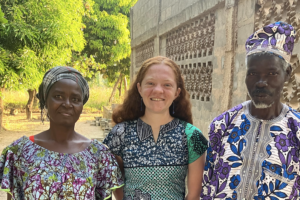
The first leg of that journey happened by accident. One day, Beverly stumbled on a brochure for Health Talents International (HTI), a medical mission that has served rural Guatemala since 1978. Its programming provided food, clothing, schooling, and medical care to children in the regions served by Clínica Ezell in Montellano. It was exactly what she and Kelly were looking for, and its faith-based mission aligned with their own values. When she called the number on the brochure, Beverly had her first encounter with Marie Bryant Agee, an early member of HTI’s staff and a relentless advocate. The two would later meet in person through their churches’ shared mission work.
The Milams soon began sponsoring as many as five children at a time through HTI. When Beverly offered to help further however she could, Bryant called with a specific request for surgical equipment. Beverly called Bob Elder, a friend from her church who led gynecology at the UT Medical Center, and he arranged a shipment. Bryant kept pressing the Milams to encourage them to come visit in person. Soon, Elder, Kelly, and Beverly were on their first flight to Guatemala.
Elder was undone by what he saw there, and he recognized immediately that his students needed to engage too. The Milams returned annually for nearly a decade, timing their visits to their September anniversary, an occasion the clinic staff would celebrate with tropical flowers and homemade tres leches cakes. Kelly, an electrical engineer, fixed whatever he could fix (he once helped restore power after a surgical team finished a procedure by flashlight). Beverly walked women to the bathroom after surgery, made ice packs from frozen water-filled surgical gloves, and read Spanish-English picture books to children in the waiting area. On the day each child was discharged, she sent them home with a book of their own.
The Milams returned to Knoxville each year looking for more help and found it in a somewhat unexpected place, the University of Tennessee. With guidance from another old friend and fellow congregant, former UT System President Joe Johnson, Beverly and Kelly connected with Buddy Mitchell at the UT Institute of Agriculture, who assembled a small team that included soil science faculty Forbes Walker and Neal Eash. The team flew to Guatemala, sat with the communities that worked with HTI and asked what they needed.
What followed? Vaccinated chickens. Rooftop rainwater cisterns. Smokeless stoves that piped smoke out of the kitchen. Raised-bed vegetable gardens, first at the clinic, then at family homes. Tilapia farms whose nutrient-rich runoff fertilized crops. Rock-and-sand water filters designed with help from a Knoxville engineer. It’s been transformational.
In the time since that first trip to Guatemala, the Milam family, now with the involvement of Beverly’s and Kelly’s children and grandchildren, have created and grown two UT endowments to support their passion project in perpetuity, with a particular interest in increasing student access to study abroad opportunities.
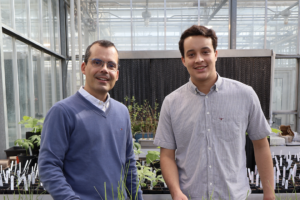
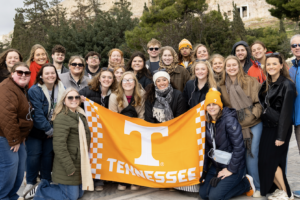
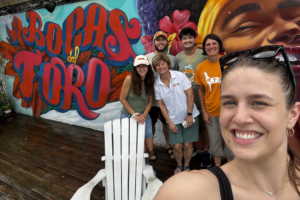
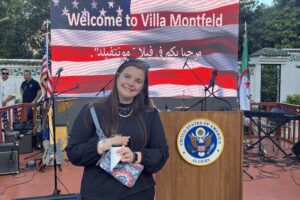
Among those who have benefited from the Milams’ vision and generosity are Delaney Turner and George Wilson. Both are seniors in the Herbert College of Agriculture, both serve as Herbert Ambassadors, and both traveled to Guatemala on a spring-break course coordinated through the Smith Center. Neither had been abroad before. Turner, an agricultural leadership, education, and communications student, said the trip was one of the first times she saw concepts from her classes at work in a real agricultural setting. Wilson, an animal science student, had never flown on a plane before starting college.
The course was hands-on by design, which was a significant part of its appeal for both Turner and Wilson. They hiked a volcano to pick avocados from trees rooted in ash, then bought other ingredients for guacamole at a Guatemalan market as a team exercise. They toured a coffee farm from bean to cup. They spent a day with a local family, comparing photos of the family’s small dairy cattle to the beef-cattle herds Wilson knows from home. They pulled weeds and repotted plants at the same Clínica Ezell where Beverly had once handed out picture books.
Both students were reshaped by the experience. “There’s no way that I could go to Guatemala and tell them how to grow their coffee,” Turner says. “My job was to learn what they do.” Wilson, still weighing whether his future is in Extension or agribusiness, said the trip let him sample many corners of his field at once — livestock, horticulture, education, regenerative agriculture — in a place he never imagined he’d travel.
For the Herbert College of Agriculture, which aspires to give half of its students a global experience, that kind of accessibility is the point. Cost is often the barrier that keeps first-generation and rural students from applying, and Turner says the most persuasive thing she can tell an incoming freshman is what she was told herself: these trips are possible because scholarships are available to those who need them. “When I tell students that, they realize they’re able to go,” she says.
Beverly Milam, now in her mid-80s and reflecting on a partnership that has outlived her husband Kelly, does not seem to consider their journey to be especially remarkable. “If you’re in the right place,” she says, “these people just appear in front of you.” The remarkable part, she suggests, is saying “yes” when the opportunity arises.
Explore More on
Features
MORE FROM THIS ISSUE