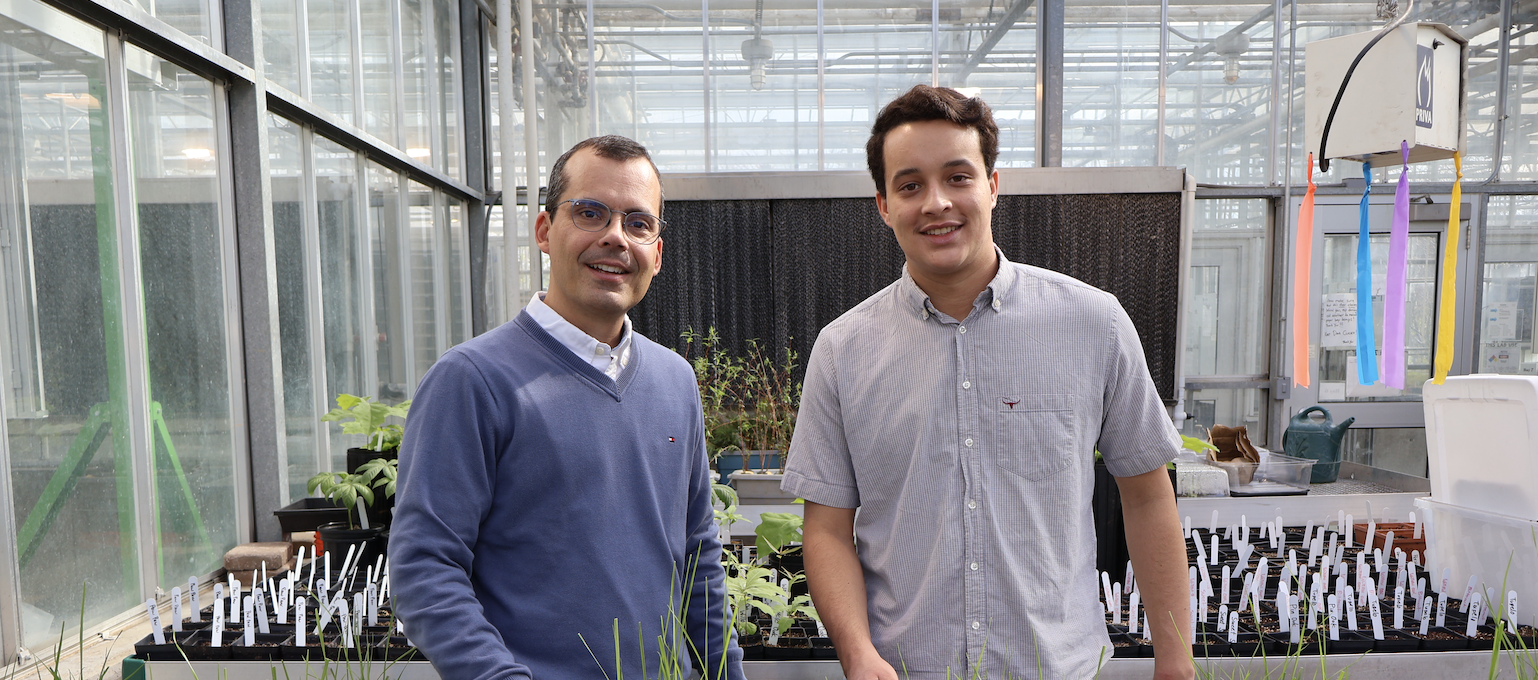
Bruno Pedreira, UT Extension forage specialist and associate professor in the Department of Plant Sciences, has long searched for ways to connect research conducted in Tennessee with our academic counterparts in Brazil. This desire to collaborate and expand research and knowledge across the globe led Brazilian undergraduate student Kaio Pereira to intern with the UT Beef and Forage Center in spring 2026.
This was Pereira’s first time in the United States, an opportunity made possible by the Research Internship Abroad Scholarship from the São Paulo Research Foundation. Working under climate-controlled conditions in UT greenhouses, Pereira researched how different soil fertilizers change the way tall fescue grass grows. Specifically, he looked at how mixing nitrogen with a mineral called molybdenum affects the plant’s roots, leaves, and overall nutritional quality as animal feed.
Tall fescue is a common forage grass species, commonly found across the “Fescue Belt,” which stretches across the southeastern United States from the mid- Atlantic to as far west as Oklahoma. Adequate forage production throughout the grazing season is essential for the profitability of beef production and ultimately the sustainability of the rural economy in the region.
During this internship, Pereira gained valuable experience in the lab, as well as in the greenhouse. Pereira was able to support research important to Tennessee producers, contribute to a national project that is ongoing in Brazil, and also gain training in advanced techniques and statistical data analysis using mixed models. As a result, Pereira is now equipped with the tools to teach others in Brazil about digital agriculture and how they can incorporate it into their research.
“Beyond the science, this experience has really widened my perspective,” says Pereira. In fact, he hopes to return to Tennessee soon to continue his research on forage grasses. In the meantime, the results and methodologies from this study will be presented at national conferences and shared through publications, further expanding its reach. This partnership with the University of Western São Paulo serves as a great example of an international experience that trains students to solve some of the world’s top agricultural problems.
MORE FROM THIS ISSUE